


Peter Brimelow writes: Tucker Carlson’s reach is amazing. This interview was posted at 2:30 p.m. January19 and at 7 p.m. two people came up to me at a meeting I was attending in downtown Berkeley Springs WV to congratulate me.
I’m posting here the lightly-edited transcript with supporting links provided by my long-time VDARE.com lieutenant James Fulford (subscribe to his substack). My subtitle is Tucker’s. Thanks to everyone.
Replacing America: Peter Brimelow on the Invasion of America, Who’s Behind It, and How Long Until Total Collapse
TC: Peter Brimelow, thank you so much for doing this. I thought of you last week when I read this. I don’t know how much you follow X, but there were a couple exchanges that suggested to me that things are changing very, very fast.
This is a tweet less than a week ago from a basically anonymous account and I’m quoting: “If white men become a minority, we will be slaughtered. Remember, if non-whites openly hate white men, while white men hold a collective majority. Then they will be a thousand times more hostile and cruel when there are a majority over whites. White solidarity is the only way to survive.”
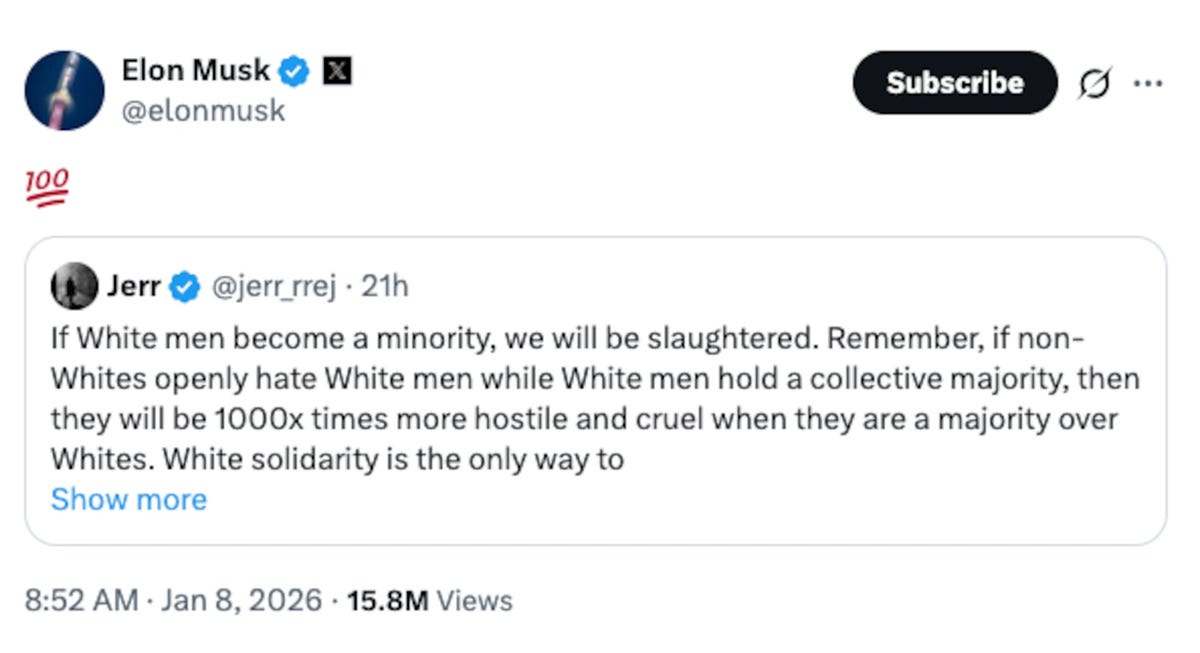
Elon Musk retweets it and says “100 percent .” And then Elon Musk writes this: “If current trends continue whites will go from being a small minority of the world population today to virtually extinct!”
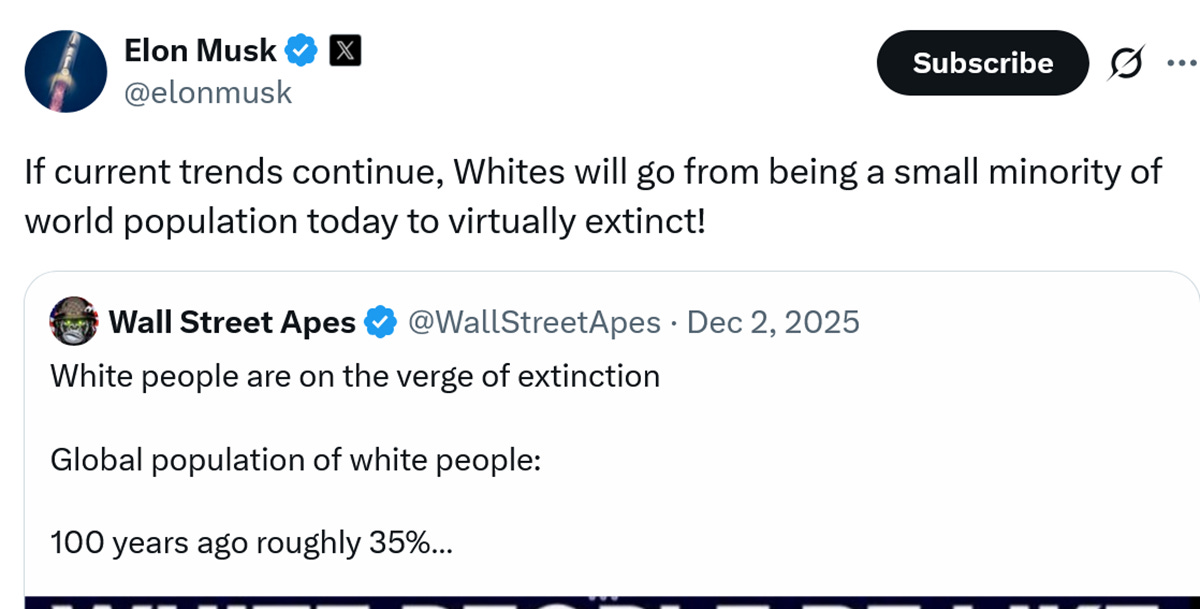
All of that, in my opinion, is obviously true, and I think most people know it.
But I read that and I thought, here’s the world’s richest man, who owns this platform and a lot of other things, saying this. And Peter Brimelow, whom I know, who’s a thoroughly decent person, has had his life turned upside down and basically been destroyed in some ways, professionally anyway, for saying things that are way more restrained for than that.
So I have to ask you what it feels like to see that.
PB: It feels kind of tingly!
TC: Tingly?!
PB: On the one hand, I’m happy that the debate has moved in that direction and the things that we were talking about 25 years ago on VDARE.com, which was my website, about Birthright Citizenship and so on, are now in the public debate.
On the other hand, we’ve been ruined, and we’re now facing personal ruin of course, because of this attack on us by New York Attorney General Letitia James.
As nobody knows who I am Tucker, I should say that, in spite of my accent, I’ve been here for 55 years and I’m a long-time financial journalist. I worked for Forbes and Fortune and Barron’s and so on.
And I wrote for National Review a lot. I wrote a cover story on immigration in 1992, “ Time To Rethink Immigration,” that’s sometimes credited with kicking off the modern debate.
And there was a brief civil war within the Conservative Movement, which we lost. Buckley stabbed us in the back and purged the magazine of immigration patriots.
And for the next while, the Wall Street Journal Editorial Page was absolutely dominant, they were going on about the need for Amnesty and so on, and there was no way to combat it.
So I set up a website, which I named VDare.com after Virginia Dare, the first English child—not white child as they always say— born in the New World. And over a period of about 25 years, we built it up into quite a force until about two years ago it was destroyed by the New York Attorney General, Letitia James. She just basically subpoenaed us to death. And she has in fact now sued us both personally and through the foundation.
So we’re a bit like General Flynn, you know. No middle class family can stand up to this. General Flynn had to sell his house and we’re going to be driven into personal bankruptcy, I guess.
TC: It’s a horrifying story. I’ve kept abreast of it through your wife who texts me and is a wonderful person. And I know that you’re a man of great personal decency and restraint and basically a great citizen and the kind of immigrant we need, and I’m grateful to have.
So the whole thing is shocking and so revealing.
But I’d like, if you don’t mind, to start closer to the beginning of this story, with your experience at National Review. You said you wrote this piece saying Time To Rethink Immigration, which I remember well.
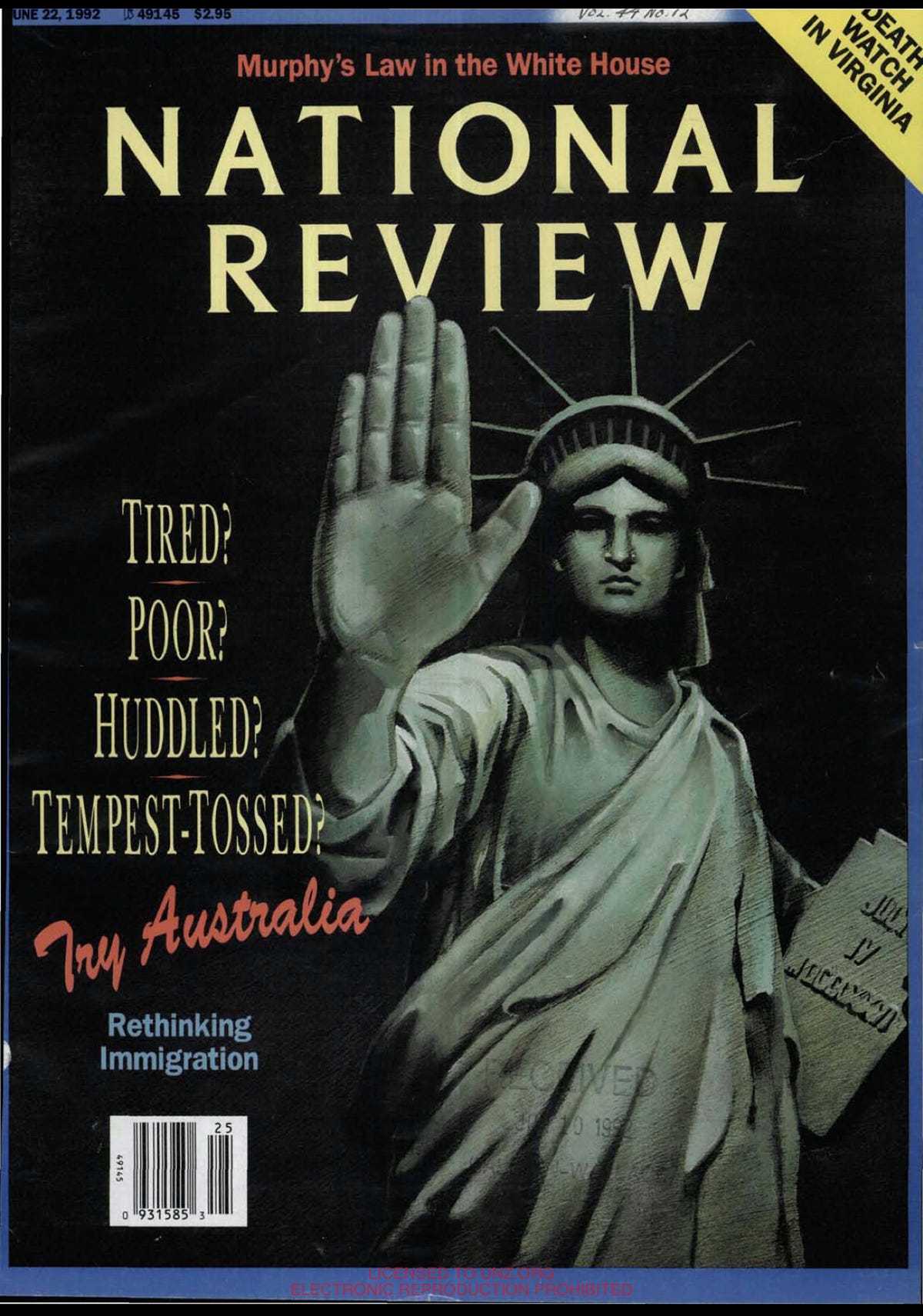
At the time, National Review really was a forum for conservatives to think through what it meant to be conservative. So that was a significant piece at the time. And then you said the then editor William F. Buckley Jr., stabbed you in the back. Can you tell the story?
PB: Sure. I was never on staff at National Review, I was what they called a Senior Editor, and I wrote for it a lot. In 1992, I wrote this very long cover story, it’s about 14,000 words. Bill had retired as the Editor by then, he was just circling around in the background, but the then-editor, John O’Sullivan, went with this story.
And for about five years, we basically directly challenged the official Conservatism Inc. line, which was that immigration is good, more immigration is better, illegal immigration is very good. That’s what the Wall Street Journal said, and is still saying as far as I can tell.
Then in 1997, Bill just abruptly, without any warning at all, fired O’Sullivan and purged the magazine of immigration patriots and basically told them to shut up about immigration, which of course they all eagerly did. He put the Washington Bureau in charge, Rich Lowry and Ramesh Ponnuru.
And so for two or three years you couldn’t get even the basic facts about immigration out to the public. But then the internet came along and rescued us. And I started VDARE.com.
TC: But why do you think Bill Buckley, who was retired and letting John O’Sullivan run it (another Brit—
PB: Yes, indeed.
TC: —who now is in Budapest) stepped back in to shut down that conversation specifically?
PB: Of course, I’ve had nearly 30 years to think about that. Over time, my answer’s evolved.. At the time I thought he was just jealous. This is actually a thing that you see–I was a financial journalist for a long time—in the corporate world. The original entrepreneurs will come back and fire the managers that they put in to replace themselves.
Also, I think the Congressional Republicans hated us talking about immigration because it upsets the donors, That was influential with Bill. He liked being lionized by the then-Republican majority in the House.
TC: So the Republican leadership, Newt Gingrich, etc., who came in in 1994 to much fanfare, achieved not a lot, they’re the ones who pressured Bill Buckley?
PB: I think that was true, but I also think that the Neoconservatives in New York hated the line. And Bill was very, very leery of offending the Neocons, people like [Commentary Magazine Editor] Norman Podhoretz. And I think they pressured him—I mean, I know they pressured—to get rid of John.
TC: Now, why would they care?
PB: Oh, because the Neoconservatives were a predominantly Jewish faction. They had this sort of Ellis Island view of America. And they were extremely frightened of the white majority in America becoming self-conscious because they felt as Jews that it might leave them out in the cold.
TC: Despite the fact there’s never been any real anti-Semitic movement in the United States—there’s no evidence that white people becoming aware of the fact that they’re white is a threat to Jews?
PB: Right
And I actually think there was a certain jealousy there. If you look at ideas on the Right in recent years, a lot of them originated out of neoconservatism. But here was a non-neoconservative faction—we would have then described ourselves as paleoconservatives—coming up with a whole new issue .
Because the immigration issue was completely dormant from 1968 when Hart-Celler kicked in, until the early 1990s. There was no discussion of it at all. I actually went through National Review’s archives and I found that they hadn’t discussed immigration between the passage of the 1965 Act until the early 1990s. People simply didn’t realize what was going on.
TC: Why?
PB: I think there are a couple of reasons. One is that there was a pause in immigration from 1924 to about 1968. So a whole generation grew up when there was essentially no immigration at all into the U.S. And so it just wasn’t an issue to them.
It’s like academic life. Where there’s a new academic theory. It’s not that it conquers the other theories by having better arguments. It’s just that the people who hold the earlier theories die off, and they’re replaced by younger academics.
And that’s true for politicians too. A whole generation of politicians had never thought about this issue. I include Ronald Reagan in that. Immigration simply wasn’t an issue when he was growing up.
And that’s why he was hornswoggled by the IRCA Amnesty in 1986. He genuinely thought that the permanent government would exchange Amnesty for serious enforcement. Whereas in fact they just took the Amnesty and didn’t enforce the law against illegal immigration at all.
TC: But I’m a little bit fixated on William Buckley because he was such a dominant force.
PB: Let me just back up a second. Looking at National Review now, it’s obviously donor-driven. And we weren’t aware of that in the 1990s. I didn’t think about donors and their role in politics really until some years later than that. We thought that people just got up and argued about issues. We just simply didn’t realize how dominant and how important the donors are.
Particularly given that Bill was not as wealthy as he wanted people to think. He depended on National Review financially. It financed his lifestyle to a considerably extent. And I think that—
TC: Wait, he depended on the magazine?
PB: Yeah, yeah—
TC: I think the rest of us thought the magazine depended upon him.
PB: That’s what he wanted you to think!
TC: And the winters in Gstaad and the sailing across the Atlantic, the Bermuda race and-
PB: I don’t know how much, but there was certainly quite a lot that was deducted or expensed to the magazine.
In any case, he just didn’t want to disrupt the donor flow. The more I think about it, the more I think that probably was the reason.
TC: Basically a species of fraud. I don’t mean against the tax code. I mean intellectual fraud. You’re making the case that you believe these things because they are true, when in fact you’re taking money to say them.
PB: My experience with Bill is that he actually was not very interested in politics. When you went to those dinners he used to put on at [the Buckley NY pied a terre] 73 East 73rd Street, it was very hard to get him to talk about politics. He was always wandering off in odd directions. And you can see that in the way he lived his life, latterly, in writing these silly novels and so on. He basically didn’t do any serious thinking about politics.
I have a letter from him, actually, saying how wonderful my immigration story was. I forget exactly what he said, but he said it was beautifully organized and beautifully argued and the tone was perfect. That sort of stuff.
He never admitted that he changed his mind on immigration. He just told them to stop covering it. The official line of the magazine was that immigration was questionable. They just didn’t do any journalism on it.
Which is how he was about drug legalization. He was officially in favor of drug legalization, but he very rarely let the magazine write about it.
TC: Huh! Why?
PB: I guess he was balancing a number of issues.
In the case of immigration—immigration was a very unfashionable subject in the early 1990s…
TC: I remember!
PB: As we were talking earlier, I was watching Ben Shapiro on Megyn Kelly. And he was attacking you for some reason or other, I forget what. And then he suddenly says, well, ““Tucker has been a wonderful advocate in the past, particularly on the immigration issue.”
Well, as I understand it, you’re interested in the idea of an immigration moratorium.
TC: Of course.
Well, this is news to me!—that’s what Ben Shapiro thinks is good about your views on immigration! Just about five or six years ago, in National Review, he called me a White Supremacist basically for no other reason than advocating immigration reduction.
In those days, if you advocated immigration control, you were immediately suspected of being an anti-Semite—even though there’s no direct connection at all.
And now they’ve changed their mind on this, they’ve fallen back. I was very friendly with Norman Podhoretz—he didn’t talk to me for the last 10 years of his life, he died just a few weeks ago, at the age of 95—and just before he’d died gave an interview in which he said he’d changed his mind on immigration! He thought there was a limit to how much immigration could be absorbed!
And he credited John O’Sullivan, the Editor of National Review, for helping change his mind. He didn’t mention me!
TC: Why didn’t he speak to you for the last 10 years of his life?
PB: Well, I think he just decided that I was a suspicious character. And I had deviated on the immigration issue.
I had the habit of calling the National Review, the Goldberg Review, because at that stage, briefly, it was dominated by Jonah Goldberg, who I think is a complete fraud and lightweight, and of course was absolutely boneheaded on the immigration issue.
TC: He’s certainly a lightweight. It’s hard to know what he believes or doesn’t, but if Jonah Goldberg is your intellectual force, then you’ve been degraded.
PB: Well, Norman emailed me and said you’ve got to stop calling National Review the Goldberg Review because it sounds anti-Semitic.
Actually, my understanding is that Goldberg is not technically Jewish. His mother was a Gentile.
TC: I knew her. She was a great person, actually.
PB: So I replied and said that. And he didn’t get back to me. He just gradually suspected me more and more of Thought Crime.
And Norman was an extremely passionate man—
TC: [Laughing] Oh, so famously!
PB: He didn’t socialize with opponents.
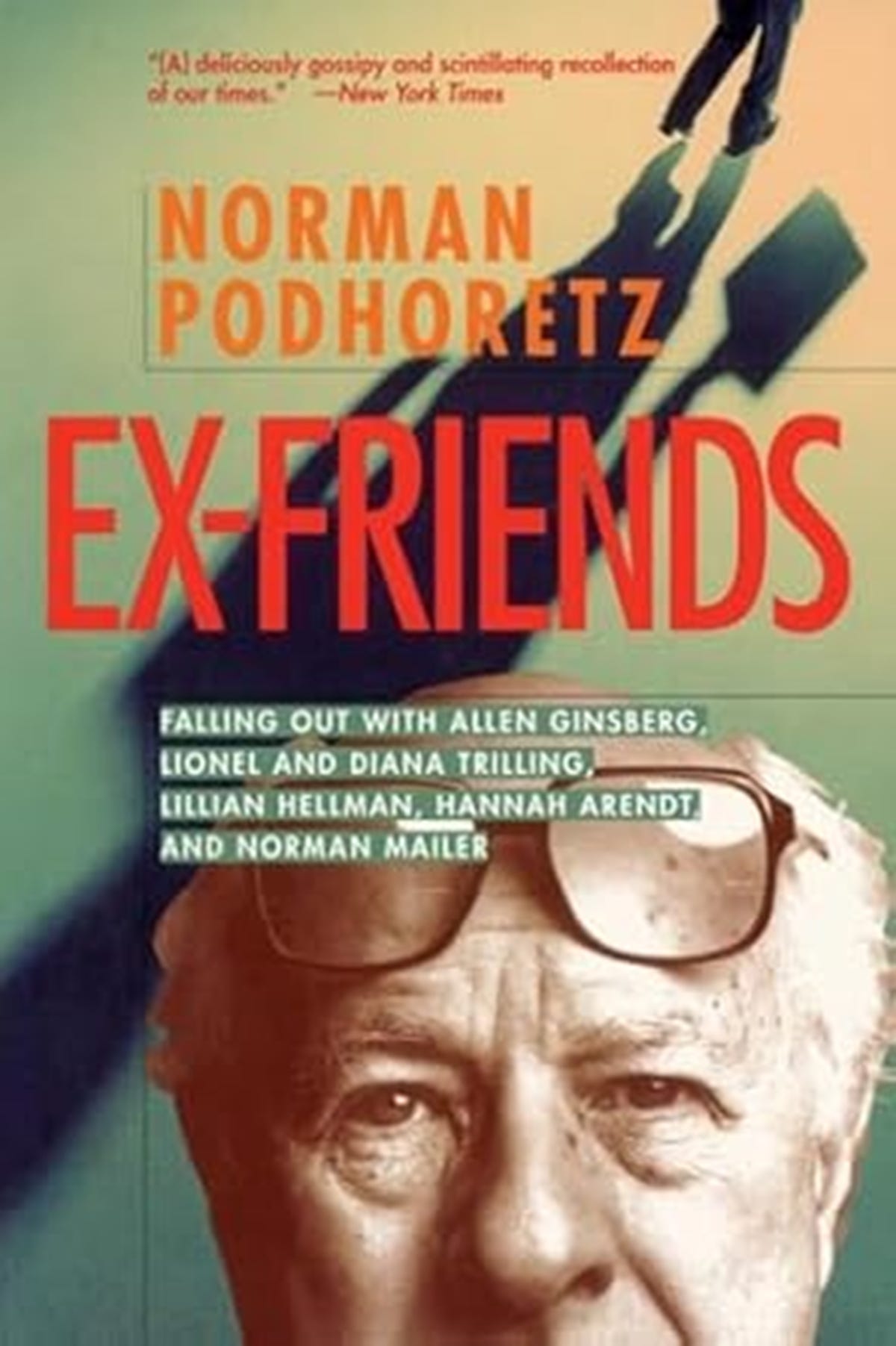
I miss him. I really liked him. I was sorry that….
TC: There was a lot about him that was appealing. He was a man of great energy, and I admired him in a lot of ways, kind of repulsive in others, but certainly he was not standing still. He was constantly in motion and I admire that.
PB: And we actually owe his wife Midge Decter a lot because she was the Chairthing of the Philadelphia Society, which is a conservative affinity group, and she invited me to speak on immigration in 2005. My first wife had just died, and that’s where I met my current wife, Lydia, who of course ran the VDARE Foundation with me, she was the publisher of VDARE.com. And you’ve had her on of course.
[Transcript of Lydia’s interview with Tucker here].
TC: Oh, of course. And I’m a fan. She’s a brave woman, and a smart one.
May I ask what happened to your relationship with Bill Buckley?
PB: When he fired John O’Sullivan, I was the only one of the entire staff who went in and asked, “Why did you fire him?”
TC: What?
PB: Yeah. Well, the official line was John had “resigned to write a book.” That was because John was very popular with the National Review base and the immigration issue was very popular. So Buckley didn’t want to admit that he was dumping them both.
So he got really ruffled, because he wasn’t used to being challenged. He said “He’s resigned to write a book! He’s resigned to write book!” And we basically never spoke to each other after that.
I was constructively dismissed from National Review. I got a letter telling me I was no longer a Senior Editor, which was actually very important in the National Review world because it was run like a fraternity. If you were Senior Editor, you were automatically invited to all kinds of events, to Buckley’s dinners and that kind of thing.
And I never wrote for it again.
TC: Why did they dismiss you, do you think?
PB: The Washington Bureau was always upset with the immigration issue because it embarrassed them in Washington cocktail parties. And Buckley put the Washington Bureau in charge of the magazine. So they were happy to do it. And they didn’t want to write about immigration.
And I think also, you know, mud sticks, Tucker.
TC: Mud sticks.
PB: So, you know, this constant whispering campaign of how I was a racist and anti-Semite for raising these issues, it has stuck. So that, even though Ben Shapiro is now in favor of just talking about immigration, I don’t see him apologizing to me.
TC: Of course not. He doesn’t care about you, or other people, at all.
PB: I just had a really interesting experience: Lydia and I were at an ISI book event and I bought Matthew Continetti’s book [The Right The Hundred-Year War for American Conservatism]. I mean I actually bought it, I put down my money! it’s a rotten, awful book, says I was born in Canada, which I obviously wasn’t.
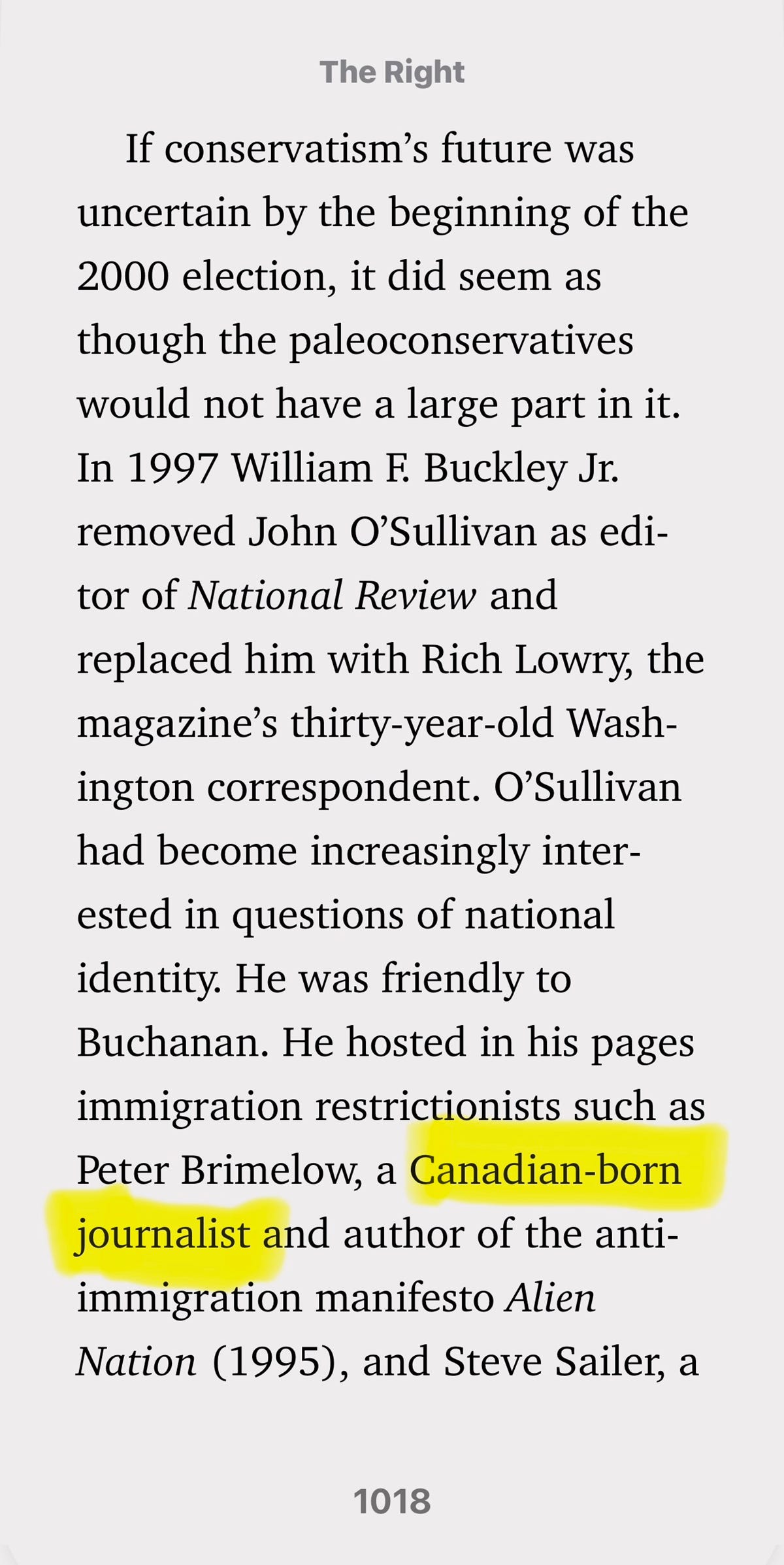
TC: Well, he’s a silly—I’m mean, this is Bill Kristol’s son in law.
PB: Bill Kristol’s son in law, well, that’s the point. I like to collect inscribed books—in fact I forgot to bring your book, I’m sorry—and he wouldn’t inscribe it. He said: “I have nothing to say to you.”
TC: On what ground? I mean, I don’t think you’ve ever said an antisemitic thing—that I’m aware of—in your life.
PB: Well, Continetti is a convert, of course , so he’s probably particularly ardent.
But the weird thing about this was that Continetti has actually written some quite sensible things on immigration, which is odd when you think of his father-in-law.
TC: But he said to your face, “I won’t inscribe your book because I have nothing to say to you?”
Peter Brimelow: Essentially. It was kind of surprising.
We live out there in the Eastern Panhandle of West Virginia and we don’t have to face this stuff. But I guess when you were in DC, you faced it all the time.
TC: Yeah, well, I left, But I also believe in forgiveness, and that’s kind of the difference, I think. We’re commanded to believe in forgiveness and to treat people as human beings.
PB: Well, Norman did not believe that.
TC: No, I’m very aware of that!
PB: It was a principled position with him!
TC: It’s a principle, but it’s a satanic principle that you can’t forgive other people. That is, you’re not forgiven if you don’t. So that’s my view. But wow, that’s amazing.
PB: Well, the thing is, he’d already signed the book, so I couldn’t return it and get my money back!
Whereas, conversely, Yoram Hazony was also there. As you know, he disinvited us from his National Conservative Conference because he was trying to gatekeep. And so we had a series of bitter exchanges in VDARE.com. But Hazony was perfectly friendly and he signed his book The Virtue of Nationalism and inscribed it and we chatted about children and grandchildren and so on.
TC: Yoram Hazony is a very courtly man, a very charming and warm person. I had lunch with him once. I don’t agree with him on a lot, but I liked him. It’s hard not to like him.
PB: I think he’s very good, a lot of the stuff he says about conservatism is exactly accurate.
TC: I think that’s right.
PB: He’s moving it away from being classical liberalism.
The problem of course is that he’s caught in this bind because he doesn’t want to admit that Israel is an ethnostate, because he does not want America to have an ethnostate. He wants it to be a civic nationalist state.
TC: What do you mean? Israel is by its own description an ethnostate. (That’s not an attack, by the way).
PB: I’ve never been able to get him to explain how you cannot say that there’s a racial component to Israel when of course the Jewish religion is racially-based. That’s why they have the matrilineal principle: you’ve got to have a Jewish mother.
And I’ve never seen him respond to that, and I don’t think he can, because he doesn’t want to encourage straight-up white nationalism in America.
TC: I just want to be clear about my own views, not that it matters, but just because I hold them sincerely. I have no problem with the fact that Israel is an ethnostate. It’s their country. They can have whatever state you want, as far as I’m concerned. But it is an ethnostate. By definition. The people who founded it were not religious. A lot of them were atheists. And they identified as Jewish racially.
Again, I’ve no problem at that at all. That’s their country. But to say it’s not an ethnostate is not only a lie, but it’s like a ludicrous lie. And he won’t admit that?.
PB: That’s my reading of what he’s saying.
But it’s one of these situations where his civic nationalism is so intense that it might just as well be ethnic nationalism. A lot of things he says about immigration to the US are excellent.
TC: Right. And I’m not attacking Yoram Hazony at all, whom I like. But that’s dishonest because Israel is an ethnostate and you should just tell the truth.
PB: Well, it’s what Orwell called double-think, isn’t it? You’ve got to believe two contradictory things at once. It’s necessary to operate in large parts of the political world!
TC: So why wouldn’t people who support an ethnostate in Israel want one here?
PB: This is the profound question about the Jewish role in the American immigration debate. They’re overwhelmingly pro-immigration. However, having said that, if you know anything about Jewish intellectual life, you’ll know there are Jews on the other side, and some very ardently on the other side
TC: Oh, I know! And I know a lot of them, That’s why I would never be anti-Semitic. You can’t generalize.
PB: I mean, I have a hunch that Stephen Miller, who, of course, is an aide to Trump, I think he’s the Deputy Chief Of Staff, he’s going to be the first Jewish president.
I like to say this because the prospect horrifies people so much!
But he’s like Benjamin Disraeli in Britain. Disraeli of course, was Jewish, but his father took the whole family over to Episcopalianism when he was young.
Disraeli basically reinvented the Conservative Party in the 19th century. He came up with a complete Grand Strategy for it, based on the British Empire and imperial patriotism.
And that really carried the party through for the next 80, 90 years. The Conservative Party was the Nationalist party, and because of being a Nationalist party it got a very substantial working class vote. Because it is the blue collar workers who are the patriots. And the Conservatives were able to tap into that.
Miller’s done the same thing. He’s invented a Grand Strategy for the Republican Party—which it desperately doesn’t want to take up because it’s run by cowards and fools. He thinks they should move towards stabilizing America’s ethnic balance and eliminating this post-1965 inflow, which is causing all kinds of problems. And he’s not afraid to say that.
And not only that, but he had the cunning to survive the Kushner White House.
TC: Yes.
PB: And that was really extraordinary because Jared Kushner, of course, believed exactly the opposite. He’s basically a liberal New York Jew. But for some reason, Miller was able to survive. I couldn’t have done that.
And I couldn’t have abandoned Jeff Sessions in the way that Miller did. Miller was his closest aide; Sessions was his mentor. And then Miller abandoned him when Trump turned against him.
I couldn’t have done that either. But then he’s in the White House and I’m not!
TC: I think those are all fair and true observations.
It’s interesting, though, the degree to which the immigration project is a demographic project. It has almost explicitly been an effort to make America less white.
They’ll say that. It’s not controversial. You could prove it on video. Didn’t even bother to, because I think most people watching this already know that its architects, starting with Teddy Kennedy in 1965, basically just said the whole point is to make America less white.
Why is it so hard for conservatives to say the same? If Democrats are saying we want America to be non-white, why can’t conservatives say that that’s what their motive is?
PB: I have to say that Kennedy didn’t say that—
TC: At first.
PB: Yes. When he was the floor manager of the Hart-Celler Act, he gave very explicit assurances—
TC: Yes.
PB: —which we love to quote, saying this this will not alter the racial balance of America and it will not mean a million people will be coming in. Whereas in fact a million people a year are coming in.
And that’s one of the reasons I bitterly regret not having VDARE.com, even though I have my own peterbrimelow.com Substack. Because we’ve got to get legal immigration into the debate.
I think what Trump has done on illegal immigration is remarkable, more remarkable than people realize. But he’s not doing anything on legal immigration.
But I’m sorry, that means I’ve not answered your question. What was your question?
TC: Well, my question was the whole point of the project was not to feed a desperate need for low skilled labor that definitely no longer exists now with AI. And it wasn’t to improve America. It’s completely destroyed America, destroyed the state of California.
PB: Well, when I was writing my 1995 book on immigration—Alien Nation— that flowed out of my cover story, and which Harper Collins refused to reprint, I quoted a man called Earl Raab who was a Jewish activist, who explicitly said that the Jews were in favor of mass non-white immigration because it makes the rise of a, he didn’t use the term neo-Nazi but that’s what he meant, party in America impossible.
[PB: Actually, he did, sort of]
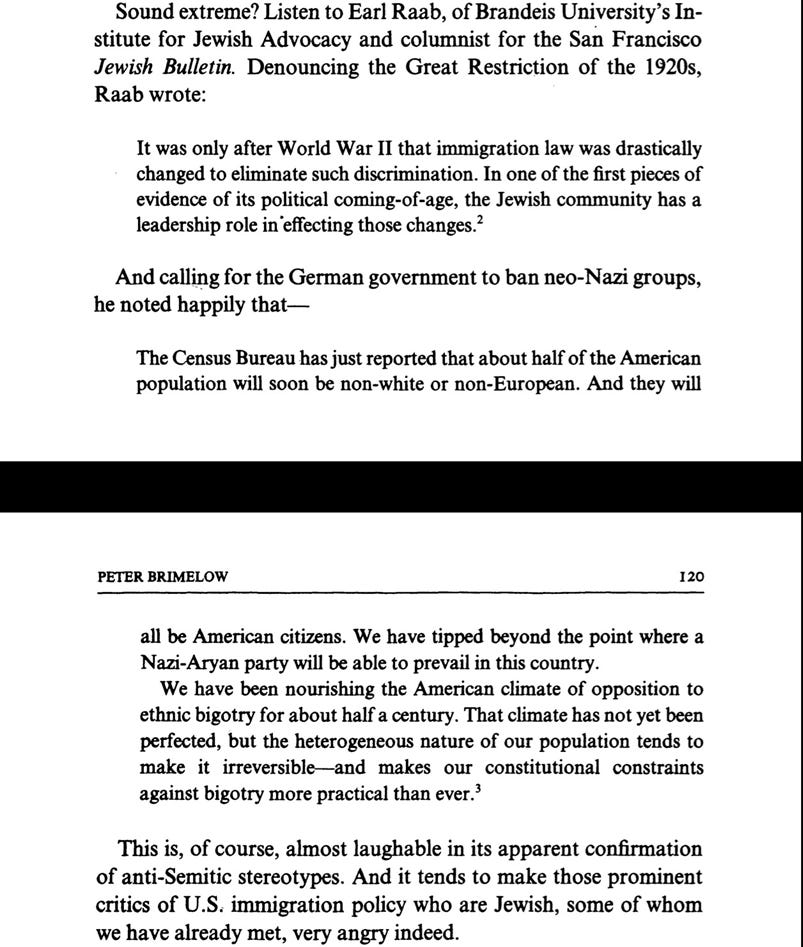
In fact it does the exact opposite, it makes it more likely.
TC: Well, exactly.
PB: But he did say that, he quite frankly said that this is why most Jews favor—
TC: It’s also made possible the rise of hard-edged anti-Israel politics—and I’m not pro-Israel, especially, but I don’t hate Israel. A lot of people who hate Israel are immigrants.
PB: Well, look at the New York mayoral race. Mamdami won because of the immigrant vote. The native-born American New Yorkers—and look at who they are, for God’s sake—voted against Mamdani.
So they’ve really screwed themselves up.
TC: This hasn’t worked. If your interest was to keep anti-Semitism and really crazy anti-Israel sentiment to a minimum—and I agree with that, I’m against antisemitism and basing your life on hating Israel—if that was your goal, you literally achieved the opposite result. Is that fair to say?
PB: Not for the first time.
TC: Yeah. Fair, fair. So maybe think maybe that wasn’t the goal. I’m just guessing here. Maybe there was another goal that we don’t understand.
PB: Well, I think a lot of it is deeply emotional and can’t be analyzed intellectually. There’s just a whole series of reflexes.
TC: Or spiritual.
PB: But, for example, we know that the New York Attorney General’s attack on was VDARE.com was instigated by the Anti-Defamation League, because a journalist we know actually got the ADL to admit that they had gone to Letitia James and told her to take VDARE out.

And we say to ourselves: why us, Jews? What have we ever done to you?
You know, we have the Berkeley Springs Castle in West Virginia, which we bought as a conference venue because we’re not allowed to have conferences anywhere else.
The donor was Jewish.
We had all kinds of Jewish donors and all kinds of Jewish writers. But that doesn’t make any difference to the ADL, apparently.
TC: Now to what happened to you and to VDARE. So you’re expelled both from National Review and you leave your old life as a financial journalist behind. I think it’s a fair summary. And then you create this organization called VDARE.com. And it becomes successful, it becomes big and it’s not anti-Semitic, it’s not racist, it’s against changing America’s population through immigration. Is that a fair summary?
PB: Well, I stayed in financial journalism for a long time. VDARE.com was kind of a moonlighting project initially.
TC: How’d you pull that off?
PB: It was very difficult. And, of course, eventually it became impossible. I was fired both from Forbes and from what used to be CBS Market Watch, it became Dow Jones Market Watch. In both cases, it was during turn-downs in the market, but they chose to fire me rather than people who were frankly less valuable to them.
So it did in the end terminate my career in the Main Stream Media.
But, on the other hand, we were developing VDARE.com very rapidly and it became quite a big deal. In 2019 we raised some four million dollars which enabled us to buy the Castle and do all kinds of other things.
Of course, it’s been utterly destroyed now. It was suspended two years ago—the whole site is still online thanks to volunteers, but we’re not updating it—and I resigned.
So I’m supporting the family now on pensions and savings and so on. And I do have a family, I have minor children. So it’s kind of irritating.
TC: Irritating doesn’t begin to describe it.
So tell the story if you would. You’re running VDARE and somehow Letitia James, who’s the—
PB: She’s the Attorney General of New York State. VDARE is a 501©3 charity and it was registered in New York State in 1999 entirely because our then pro bono lawyer happened to be barred there and it was convenient for him. This was there was a Republican governor in New York and nobody ever heard of lawfare or Letitia James. The idea of this kind of exploitation of regulatory power had never occurred to anybody.
Well, because we were registered in New York, even though we don’t operate in New York, one day we woke up and found we had been hit with these massive subpoenas demanding all kinds of documents, including all our email going back to 2016.
And of course that was a huge problem because, if she got our email, she would have the names of our donors and our pseudonymous writers. And I had people writing for me whose careers would have been ruined if they were found out.
TC: So you’re not domiciled in New York, you’re not operating in New York, but the 501c3 is registered in New York?
PB: And you can’t get out, you’ve got to have her permission to get out.
TC: You can’t change states?
PB: Only with her permission. And in some circumstances, if we were to set up another 501c3 and start operating out of that, she could claim that we were transferring assets and claim jurisdiction over that. It’s a huge mess. We had very expensive lawyers looking at it for a long time even before she came along and hit us.
TC: But may I ask on what grounds she should subpoena you in West Virginia?
PB: They don’t have to give grounds. What she said was she wanted to investigate the castle purchase, which we did, or more accurately I should say Lydia did, in 2020.
Because as you know, we had maybe a dozen, depends how you count, but a dozen or 15 conferences canceled our conferences. Hotels would accept a booking, then they would cancel as soon as they came under pressure from the Left. And we realized we were never going to be able to have a conference, so we bought our own venue.
And James wanted investigate that.
Well, of course, that purchase was very carefully lawyered precisely because we knew she would want to investigate it. But it doesn’t make any difference. She demanded the details and she demanded all kinds of other things.
The really killing thing for us was demanding all the email. We had to turn over more than a million documents and we knew, if she got the writer’s names and the donor’s names, she would release them.
She did that with Nikki Haley. She leaked the donors to her PAC. And the papers that were leaked had the stamp of the New York Attorney General’s office.

But of course nobody ever came after her.
TC: I’m just confused. Did she have evidence you committed a crime?
PB: No, she was looking for evidence. And she’s not found it, but she’s charged us—well, not charged because it’s a civil case—suing us anyway.
TC: My guess is that the Trump administration will begin to ignore the courts in some cases. And people will say that this is the beginning of Fascism and the destruction of our legal system. And you know, that’s a fair point—
PB: No, it’s not a fair point! The legal system already has been destroyed!
TC: That’s exactly what I was about to say.
And when the Attorney General of the state you don’t live or operate in can destroy you because she doesn’t like your opinions, then we don’t have a functioning legal system, period. And this happened before Trump.
PB: One wonderful thing that has happened within the last year is that a very enterprising journalist actually dug up a speech made to the ADL at their 2022 conference called “Taking Hate to Court.”
Rick Sawyer, who is one of Letitia James’ operatives, the one who’s leading the charge against us, said to this conference that “Hate Speech”—that’s us— is protected by the First Amendment. But, he said, there are ways around that. All you have to do, if it’s a charity and you have jurisdiction, is issue subpoenas. He said “it sucks to be sued.” Just subpoena them to death.
And of course, that’s exactly what they’ve done to us. They inflicted maybe million and a half dollars in out-of-pocket costs for lawyers and so on, let alone the hundreds of hours that Lydia had to spend digging through documents, which meant that she couldn’t fundraise or do any other work. The process is the punishment. They just destroy you that way.
So when we saw Sawyer’s incredible statement, we thought, oh, now it’s all over. They’ve admitted that what they’re doing is political. Tt’s not because of some regulatory concern.
But we’ve been totally unable to get the federal court to pay attention to this.
We’re trying again now. We have what they call a Section 1983 action against Letitia James and her operatives personally. And we’re trying to raise this First Amendment question there. But the courts have been extremely resistant to looking at it.
TC: I mean, if the Attorney General or staff are admitting they’re destroying you because they disagree with your opinions, it seems to me that any Federal Court would take that up—because that’s a foundational question
PB: That’s what we thought. But in fact, the first time we did it, they came up with a technical excuse to dodge it. We’re trying again now. We just have to hope for the best.
One of the things that is clear to me from looking at our litigation experience—which is now considerable, goes far beyond this situation—and at all the cases I’m aware of—is that there seems to be some message that’s gone out from Judge Central that anything that’s quote-unquote “white nationalist” has got to be suppressed by any means necessary.
The classic example in our case: we had an hotel cancel us in Colorado Springs. Our quarrel was not with them, because they paid up the liquidated damages like men (and it was a lot of money). But they cancelled because the mayor of Colorado Springs, who was a RINO, John Suthers, had said he wouldn’t extend police protection to the conference. In other words, Antifa could go in and he wouldn’t extend police protection
TC: John Suthers, the mayor of Colorado Springs, basically threatened to allow mortal violence against you if you went to his city?
PB: That’s right.
Now, this is an issue which has been extensively litigated in the Civil Rights Era. The point was then made very clear by the courts: local governments have to extend protection to people’s First Amendment rights.
In other words, in those days the black demonstrators would have meetings in the city and the local whites would be angry about it. Well, those whites had to be kept away. The blacks had to be allowed to have their meetings.
Civil Rights litigation is extremely damaging if you’re on the wrong side of it. There’s enormous damages involved. So it would have been a huge victory and we would have been made whole in a very dramatic way.
Our initial lawyer in Colorado Springs was so keen on this, it was so obviously an open-and-shut case, that he took it on contingency. But as soon as he realized that the city was going to resist, he ran away. We had to start paying lawyers to litigate it.
The Appeals court in Colorado rejected us. We had one good (Jewish) judge there [Judge Harris Hartz], who said this is obviously an attack on VDARE’s First Amendment rights. But the other two, who I think were Republican appointees, voted against us.
Well, we fought it right up to the U.S. Supreme Court, which refused to accept the case.
So we lost.
But subsequently there was a case before the Supreme Court, NRA vs. Vullo. The communists in New York State were putting pressure on insurance companies not to insure the NRA. And the NRA fought it and won it at the Supreme Court 9-0.
And in a concurring opinion, Justice Ketanji Brown Jackson said, in effect, that the NRA’s case is strong, but it’s not as strong as VDARE’s case where they were denied police, where the state agency basically discriminated against them on political grounds.
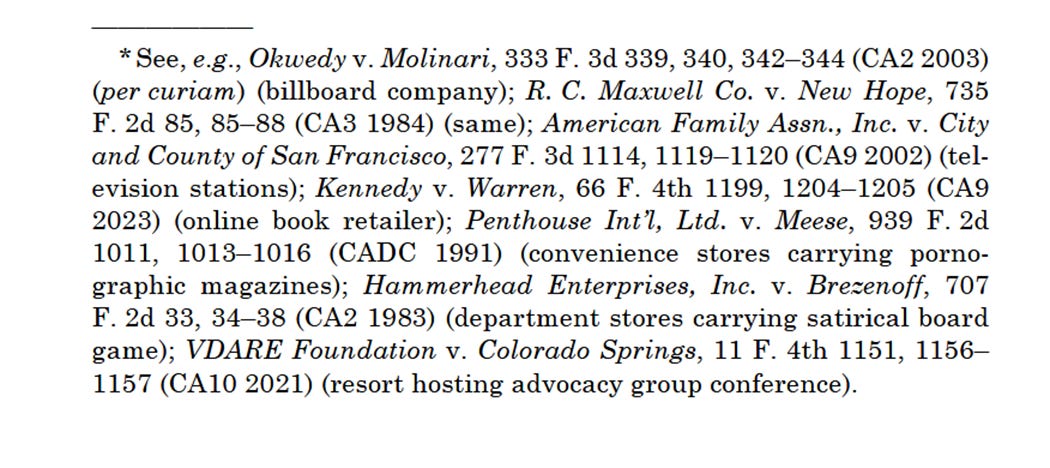
We said, what’s this? We never heard about this!
Well, it turned out that eighteen state attorneys general had signed an amicus brief saying that the Appeals Court in Colorado had been wrong to reject our attempt to sue Colorado Springs, for the following reasons. And that therefore the Supreme Court should take up the NRA’s case against New York. And the Supreme Court did take it up and ruled against the state of New York 9-0.
Which of course does us absolutely no good whatever, because we’re out all that money and our First Amendment rights are still not protected.
I mean, in other words, there’s a real determination on the part of the judiciary—the NRA is apparently more palatable than we are.
TC: I’m a little bit confused conceptually with the idea that white self-awareness is effectively illegal in the United States, whereas ethnic self-awareness in every other group is encouraged. It doesn’t make any sense.
Speaking for myself, I’d rather live in a deracialized world where people think about it less because it does cause problems. But as long as you’re encouraging Identity Politics, why do whites not get to have it? What is the answer?
PB: Well, it’s completely hypocritical. It’s because the people running the society are anti-white and they’ve been able to persuade or intimidate the entire legal system to operate in an anti-White way.
Anti-White in this case really means anti-American, I mean, because whites are Americans. That’s who Americans are, you know, the people who signed the Declaration of Independence.
TC: I did know that.
The defining fact of our lives is that whites around the world are being eliminated and I would like to know why. Do you have any guesses?
PB: As I say, I think it derives from emotion rather than a kind of rational calculation. I mean, if you look at what’s happened in South Africa, or for that matter in every big American black city that’s majority black, they can’t want it to get into a situation where the water is putrid and nothing works and all that kind of thing, but they do. The purpose of a system is what it does.
TC: That’s right.
PB: And the purpose of non-white governments is to produce non-white government and non-white results.
Unless of course you’re Chinese, or Japanese, because Singapore, Japan, they’re run very efficiently.
TC: They are. It’s just interesting that people move here because it’s a white country and—
PB: They run it right into the ground.
TC: Yes. All of us benefit, white and non-white benefit alike from systems created by whites because they’re more humane, they’re more just, they’re more fair and they’re much more efficient and cleaner. Obviously.
PB: You know, I was looking at an interview I did for FORBES Magazine with Milton Friedman. I asked him, are there cultural prerequisites for capitalism? And he said yes!
As you know, Friedman was very fire-breathing libertarian. But he had actually thought about this question. He said, capitalism has really only ever worked in English-speaking countries. He said, I don’t know why this is so, but the fact has to be admitted.
He agreed that there’s some kind of a cultural underpinning for capitalism—what economists call a metamarket, a framework.
So the question is: why is the Chamber of Commerce suing to keep the H-1B flow coming when it’s obviously going to produce people, like Mandami, who don’t support capitalism—in fact, hate it. What are the capitalists doing?
Well, they’re doing what Lenin said: They will sell us the rope with which we hang them.
TC: That’s demonstrable. It was true in 1917. It’s true in 2026. Do you think it’s the product of short-term thinking?
PB: Oh, in the case of business people, of course it is.
But, due to the malign influence of the Wall Street Journal Editorial Page, a whole generation of businesspeople do genuinely believe all this nonsense.
It’s very hard to get this out of their heads because criticism of immigration is never allowed on the Wall Street Journal Editorial Page.
TC: So you’ve referred repeatedly to the Wall Street Journal and also to Harper Collins. Both of them are owned by the Murdoch family. What’s been your experience with the Murdochs?
PB: Well, you know, I spent well over a year working for Rupert, in 1990, ghosting his autobiography, which was never published. For various reasons, he changed his mind.
But I have to say he was extraordinarily generous to me personally. And he continued to be extraordinarily generous until very recently. I had been on the payroll quietly for a very long time and they dropped me when you came under attack, because some communist looked into it and they found that this Thought Criminal was on the payroll. So at that point I was dropped. But he’s always been extraordinarily generous to me.
TC: That is my experience with Rupert Murdoch.
PB: And that’s not the case with a lot of these characters, a lot these Media Moguls, like Robert Maxwell. I remember Rupert telling me once that he thought that Maxwell— Maxwell, as you know, allegedly fell off his yacht off the Canary Islands and was found dead—Rupert’s theory was this guy is such a jerk, the crew probably just couldn’t stand him anymore!
TC: That is one theory. His lawyer told me that he was murdered by the Israelis for whom he worked. I don’t know the truth of that. But he certainly had a lot of enemies and there were a lot of suspects in that death.
PB: But that’s not the case with Rupert. He’s not cruel. He’s not vindictive.
TC: Rupert is one of the most personally gracious people I’ve ever met in my life. He has perfect manners. He is truly Anglo in that way. And I never had a bad time with him. Even when he fired me, I talked to him after and he couldn’t have been nicer. So I strongly agree with your assessment. He kept you on the payroll for decades?
PB: Yes. I had five children born on his health care!
TC: I had some born on his health care too! God bless you, Rupert Murdoch!
PB: It was very good!
TC: The truth should be told, good and bad.
PB: So, essentially, I was a consultant for him and he didn’t consult with me at all! Because, of course ,I would have told him to do the exact opposite of what he was actually doing.
But I have no complaints about Ruper Murdoch.
TC: Yes, I agree with you 100% through much experience, 25 years.
But it does raise the question, as it does with Bill Buckley—Rupert has great personal decency, but his editorial product is aggressively opposed to basic American interests. What is that? This guy likes America. He treats people around him well There’s a lot of good to say about Rupert. But the Wall Street Journal, the New York Post, HarperCollins, all of them, are engaged in a very aggressive campaign against America’s interests. So why is that? Do you know?
PB: Well, I think he handed over the intellectual, the thinking part, of News Corporation, or 21st Century Fox, whatever it’s called now, to the Neoconservatives. And so he took on a lot of Neoconservative baggage at that point.
I mean, the Wall Street Journal used to run an editorial every July 4 saying there ought be a constitutional amendment: There Shall Be Open Borders. It was really lunatic. They may still do it.
TC: But why would he do that?
PB: First of all, because they’re very good! They’re extremely active, full of ideas, full of energy. And they were extremely good on the Cold War.
TC: They were. That’s correct.
PB: But that was then, and this is now. And they just simply haven’t made the transition.
That’s a major reason. And also he was operating in New York, and he was under a lot of suspicion there, and he had to show what he was, what Gore Vidal called once, an “O.K. Goy” , And he’s showing that.
It’s genuine, though, with Rupert. I remember once talking to him about why he was so pro the initial Iraq war, the 1991 Gulf War. He said, “Well, you know, it goes back to my father and Gallipoli.”
His father, Sir Keith Murdoch, as a journalist, played a major role in discrediting the Gallipoli expedition, which was this attack orchestrated by Winston Churchill to break through the Dardanelles to get to Russia, to help Russia in World War I.
He said: “So I’m just, I guess I’m just basically anti-Arab.”
I said, “Those weren’t Arabs! They were Turks!”
He said “Aah, you know, they’re all the same!”
TC: Well, the Ottoman Empire is gone and they’ve done an enormous amount of business in the Gulf with Arabs who helped finance his companies.
So that’s not much of an answer. Is it?
PB: You know him better than I do, Tucker!
TC: I don’t know. He’s had such an effect on the world and on my life and, as I ‘ve said five times, I’ve always liked him and still do. But it is a mystery.
PB: Well, one of his henchmen in Australia said to me that Rupert is a businessman who wants to be a journalist and his father was a journalist who wanted to be businessman. Because Sir Keith Murdoch did found a publishing empire in Australia.
I think there’s a lot in that.
I mean, you and I are professional ideologues, Tucker. But Rupert is not a professional ideologue. He’s somebody who spends all of his time looking at numbers. He’s got a fantastic memory for numbers. I can never remember any phone numbers. He remembers every phone number he’s ever dialed. Running an operation like his requires a tremendous attention to detail and a tremendous application to going over pages and pages and pages of figures.
And I don’t know that he spends a great deal of time thinking about politics. Except in a sporting sense. He likes to be backing winners and winning elections and that kind of thing. But then he likes going to Australian Football Cup Finals, too. So I think it’s kind of a similar thing.
TC: That is a very smart analysis. I think you’re exactly right. He’s outsourced a lot of the thinking to others. It’s transactional. He’s not tightly wedded to ideological details at all. But he’s really allowed the Wall Street Journal Editorial Page to become a force of destruction.
PB: Well, I have to admit, it’s many years since I bothered to read The Wall Street Journal Editorial Page.
TC: Me too!
PB: I rely on people sending me things, and they don’t send much from The Wall Street Journal, or for that matter, from National Review.
TC: Is National Review still in existence?
PB: Apparently so, it has the Republican Establishment to support!
TC: Like Lindsey Graham and Ted Cruz! Do you know the Editor of National Review?
PB: Rich Lowry? He’s been gone for some time now, hasn’t he? [Wikipedia calls Lowry “former editor and now editor-in-chief of National Review.”]
TC: But did you know him?
PB: No. I sat in rooms with him and I went to cocktail parties with him. Absolutely no memory of him at all. He never said anything at all of significance. And I think that’s why Bill hired him, because he was completely malleable.
TC: Yeah, I think that sounds right. How much has been lost!
So, speaking of lost, what happened to VDARE.com?
PB: VDARE.com was suspended in July of 2024 because we just ran out of money. The VDARE Foundation is still in existence and Lydia is the last employee. She’s not being paid, but she’s still paying lawyers and dealing with the legal situation, which continues to ramify. We’re being sued personally and through the Foundation.
TC: On what grounds?
PB: Oh, fundamentally on technical issues to do with whether we had the right number of directors vote on the right number of things. It’s all paperwork stuff. It is all stuff that would normally be resolved with a phone call and possibly refiling and stuff like that.
They’ve not found any evidence of misappropriation of funds. In fact, we’ve just moved to dismiss on that basis.
TC: Who is suing you?
PB: New York State.
TC: So they’re using tax dollars still to sue you?
PB: Oh yes, that’s right. Enormously. They’ve spent a great deal of money on this.
They also, very weirdly, subpoenaed Facebook for all our records of all our dealings with them.
Well, Facebook banned us in 2020 as part of Zuckerberg’s campaign to defeat Donald Trump. They apparently thought we were pro-Trump. So we actually hadn’t had any dealings with Facebook for more than two years when Letita James came after us.
But nevertheless, she got all these records off of Facebook—but she’s not charged us with anything relating to them. Because of course, there’s nothing there.
I think they genuinely thought that they would find that we were accepting money from the Russians.
TC: The Russians?
PB: To run bot farms. Do you remember that was the allegation about Russian interference in 2016—that the Russians were financing tiny little Facebook pages and that’s how they were manipulating the election? T
I think they genuinely believe that. I think one of the things about Democrats is that they really do believe their own propaganda. They really do think that Middle America is full of people wearing pointed hats.
TC: Oh, we’ll be at war with Qatar by the end, just because they’ve talked themselves into believing Qatar secretly controls America—as they did with Russia. Then we went to war with Russia and we’re still at war Russia over that.
PB: The difficulty with this is that the Republicans believe in Democrat propaganda too! Which is why they won’t, for example, appeal to the white vote.
One of the things we did at VDARE is we discussed and documented what we call the Sailer Strategy as opposed to the Rove strategy. In 2000, Karl Rove was saying that the Republicans have got to do outreach to minorities. And it makes no sense statistically, because I think George W. Bush got like 54% of the white vote. It’s an appalling performance.
So Steve Sailer. who was one of our writers, whom you’ve had on, pointed out that if the GOP could just increase their proportion of the vote to what Bush’s father got, which was like 59%-60%, that would swamp and overwhelm any possible conceivable gain among minority voters.
So we were saying the GOP should go for the white vote.
Now, this caused a great deal of trouble for us. I remember there we got an email from the supply-side evangelist Jude Wanniski. Do you remember Jude Wanniski?
TC: Very well.
PB: He said, Peter, you’ve gone too far.
In other words, an appeal to the white vote is not allowed.
But it’s just a question of arithmetic! There’s more of them than there are of minorities.
TC: Why was Jude Wanniski mad?
PB: Jude was a liberal way back when, and he still had a lot of those reflexes. But people just get very emotional about this and they still do think it is illegitimate.
For example, look at Virginia in this last election. Youngkin, who’s a complete Wall Street cypher as far as I can see, chooses as his successor in the gubernatorial race a candidate who was 1) an immigrant 2) a woman 3) black—she’s a black Jamaican immigrant. And this is how they’re going to appeal to the white vote. They’re going to get people out of the hollows of southwest Virginia to vote for this black immigrant?
It’s ridiculous. And of course they’ve got a terrible share of the white voters, like 53%. and that’s why they lost.
But they would rather lose than make a full-out appeal to white voters.
TC: Winsome Sears was not a good candidate. They chose her because she was black, despite the fact that she wasn’t good at her job.
PB: And this is epidemic in the Republican Party.
TC: Well, it’s epidemic in the country.
PB: But the Republicans have chosen so many black candidates. You’re about to see it here in Florida. Their next gubernatorial candidate is likely black unless a miracle occurs.
Why is that? They’re just, pixilated by this, transfixed by this—I’m trying to find the right word.—hypnotized by the whole race question.
They’re just race-whipped, is what it comes down to. They’re just so afraid of being called racist that they’d rather lose with a black candidate than run a candidate who appeals to whites.
Trump does appeal to whites. Not enough. But he does it in some kind of really implicit way. If you actually look at what Trump said, in spite of all the criticism, he’s not said anything that’s explicitly white nationalist or anything like it. I see no sign that he’s anything other a civic nationalist. But for some reason he’s made a connection.
All throughout West Virginia, while Biden was president, you would see these signs supporting Trump and saying very rude things about Biden.
And this is a poor area. These are run-down trailer homes that you see with these Trump signs on them. For some reason Trump made a connection with them. it’s eerie.
Now on the other hand, he also had a disconnection with the other side! So you get this Trump Derangement Syndrome. But he was able to mobilize the white voter.
TC: Why do you think that was?
PB: There’s a concept in sociology called the implicit community. Communities that represent or appeal to some people without actually saying it explicitly. One example is NASCAR. Why is NASCAR a white stronghold? Why is everybody watching NASCAR white?
And the NASCAR operatives don’t like it. They hate it.
TC: Yeah, they’re constantly trying to diversify.
PB: The Republican Party is a classic example of this. Without ever doing anything to deserve it, Republicans have become absolutely unbeatable in West Virginia. And you and I both remember then when the Democrats were unbeatable in West Virginia. The last Democrat to carry West Virginia was Clinton. And now the Democrats have ceased to exist in West Virginia, even though it’s a very poor state. But it is 90% white,
TC: Bill Clinton lost California in 92 and won West Virginia. That’s how much has changed.
PB: So there’s something that’s going on at a very deep psychological level. There’s some kind of implicit signaling. And it’s baffling.
Now, of course, Trump did say, when he came down the escalator, just a few words about Mexican immigration. And he never looked back.
So he obviously struck a nerve there. Simply by raising immigration in his—I’m sure it drives Stephen Miller crazy—incoherent and peculiar way, constantly forgetting his lines, saying the wrong thing when he does talk about immigration. But he did raise it. And until then ,it had been driven out of Republican politics completely.
I know! We complained about it for 16 years!
TC: You were fired over it!
PB: There was almost no sign that any Republican would pick it up. But when he did, the dam broke. Now, a big difference that I find, Tucker, is that you speak to grassroots Republicans, as opposed to elected Republicans, the consensus is overwhelming that immigration has got to be ended. The consensus is overwhelming.
Whereas when I got involved in this in the early 1990s, a lot of Republicans had never heard of this question. And they would assume, for example, that immigrants don’t go on welfare to the same extent that native-born Americans do. Which is completely wrong, it’s completely the reverse of the truth, and it was back then, it was obvious that they were going into welfare in disproportionate numbers.
But people didn’t know. And the Wall Street Journal was not telling them.
Well, the Wall St. Journal still isn’t telling them, but they do know now. And maybe we played a role in that.
TC: Well, yeah, and it’s had such a complex and degrading effect on the native-born population. It’s not just a matter of competition in the job market or “My tech job went to an Indian.” It’s way more complicated than that. As immigrant communities became totally dependent on federal benefits, it changed the incentive structure for native-born communities, and a lot of them started going on at higher rates also. It created a vortex that’s hurt everybody, I think, especially the whites.
Where does it go from here?
PB: If I was still running VDARE .com, and now with my own website, peterbrimelow.com, what I’d focus on is legal immigration. Legal immigration is still running at a million a year. Now that puts in context the fact that, nevertheless, the net foreign-born population in the US has still fallen about two and a half million just during this year. That suggests an extraordinary gross outflow.
I used to track on VDARE.com the foreign born population because it’s a way of tracking the impact of immigration. It very rarely goes negative month-over-month. It went negative briefly when Trump first got in because they were frightened of him and a lot of illegals left; and then before COVID it was falling because of various technical executive action measures that Trump had taken to tighten up on both legal immigration and illegal immigration.
What we really need is an Immigration Moratorium. And I’m delighted to say that there is a bill proposed by Rep. Chip Roy in the House. It’s called the PAUSE Act moratorium.
And there are several other very interesting bills. A very good bill on birthright citizenship. And a bill to secure the border—in other words, it codifies Trump’s Executive Actions.
Tighten up on the Executive Action, tighten up on the southern border. Because we know that when the Democrats get in they’ll reverse it. But they won’t be able to do that if it’s in the law. They’ll have to pass another law and they’ll have to admit what they’re doing.
The problem is that the White House seems not pushing any of these bills. And unless they do, I don’t think that Speaker Johnson is going to raise anything. He’s just going to lie low.
I don’t know why the White House isn’t pushing these bills. Of course Trump’s got his hands full in Minnesota, where they clearly need to declare the Insurrection Act. And they keep going around blowing up foreign governments and sinking ships and stuff. I mean, which must be very entertaining.
But I would really rather than focus on ending this immigration disaster. You know, it’s whatever it is, 34 years now since I started writing about this in National Review.
I’m 78. I can’t wait much longer! I think that they should just get on with it.
TC: And you have a number of children.

PB: Well, that’s really the point. I get attacked all the time for being an immigrant with my views. My position: I’m an immigrant doing a dirty job that Americans won’t do!
But the real reason is: I have children here. My youngest child is 10 years old. God knows what the country’s going to be like by the time she’s a grown woman.
TC: Are you bitter?
PB: I’ve been extremely blessed in my personal life, even though my first wife died.
I think things could have worked out differently for me professionally. But in my personal life, I’m very blessed.
TC: You don’t seem angry. My read is that what happened to you is grotesque and is evil and not the kind of thing I thought would ever be allowed here. So I’m shocked, o hear your story.
PB: I guess I am bitter at the Conservative Movement, people in the Conservative Movement I’ve known for 30 or 40 years who basically haven’t defended us.
The most prominent people who have defended us, Tucker, are you and your friend Laura Loomer! So that just shows how ecumenical we are!
TC: So Loomer helped you?
PB: Oh, yeah. She supported us on Twitter when we were trying to raise money to defend ourselves. And we now have a GiveSendGo, which I just launched before Christmas, frankly to help us personally, because of course we’re now facing tremendous legal costs personally, and I believe she’s helped us with that.
TC: Have you received any help from the Department of Justice?
PB: Not directly. On the other hand, Trump can’t stand Letitia James, quite rightly, and they’ve made various attempts to bring her to book for various crimes, for one thing. I mean, she’s clearly guilty of massive mortgage fraud going back over 40 years.
But, you know, the obverse of lawfare run by Democrats is jury nullification by Democrats.
They’ve been unable to indict Letita James basically because Democrat judges keep disallowing the prosecutors and because Democrat grand juries won’t indict Democrats. So I don’t know where that stands.
They also have an investigation into Letitia deprivation of Trump’s Civil Rights in these scandalous cases, this Hush Money case and the Fraud case. They should never have been allowed to go to court. The judges should have stopped them. But of course, the judges are on the other side.
What’s happening is these Democrat Senators not only have the power to veto federal judicial appointments, but they also the power apparently to veto federal prosecutors. And they’re apparently taking the position that they won’t allow the appointment of a federal prosecutor if he’s likely to prosecute Letitia James or any other Democrat.
And God knows there are enough Democrats out there that need prosecuting.
We’re looking at slow motion Civil War here. New York has essentially seceded—Minnesota essentially has seceded—from the Union. Their entire legal systems are opposed to what the federal government is doing.
Jonathan Turley, who is a First Amendment specialist, wrote recently that New York is “the land that law forgot” because normal legal norms simply don’t apply there. What happens is what the Democrat operatives want. This is not a government under law.
So, in effect, New York has seceded from the union.
And that’s why I think ultimately we’re going to have to go to Insurrection Act.
And we’re going to have to go to the wholesale impeachment of judges. All these judges brought in by Biden—I think he had one or two white men, both of whom were gay, something like that. All the others are women and people of color and so on. And they deliver the most extraordinary rulings, disregarding the plain letter of the law.
Ultimately they’re going to have to be purged out of the judicial system.
TC: When that happens, Trump will be attacked as destroying the Third Branch of government. But it’s been completely destroyed long before Trump.
PB: Right, right.
TC: My last question to Peter Brimelow, and thank you so much for doing this: are you hopeful?
PB: One of the sayings I want to be remembered for is based on a talk I gave in about 2015: miracles happen quite often in politics! I mean, nobody expected the Soviet Union to collapse. Are you old enough to remember that?
TC: I’m 56. Yeah. I remember it like it was yesterday.
PB: I mean, that’s literally true. Nobody, either on the left or the right, expected the Soviet Union to collapse.
On the other hand, you know, I don’t think they expected the Catholic Church going the direction it went in Vatican II.
And on the third hand, nobody expected Trump.
And he has been a miracle. I mean, he’s changed the situation so many ways, not of which I think he has probably thought about, but he does anyway.
So I’m hopeful because I think miracles happen in politics frequently.
But we need one.
The situation right now is that we’re headed a very bad direction. Democrat politicians are openly calling on people to disobey federal law, to physically prevent ICE from deporting illegals. That’s more extreme than anything that ever happened in the South during desegregation.
TC: Much more. It’s more extreme than what the South did at Fort Sumter.[Note: No one actually died at the bombardment of Fort Sumter.] I mean, this is insurrection. Actual insurrection.
PB: Insurrection. That’s right. It’s insurrection. And, of course, Eisenhower and Kennedy did use the Insurrection Act to impose integration.
Trump has changed the situation so many ways, not of which I think he has probably thought about, but he does anyway.
So I’m hopeful because I think miracles happen in politics frequently. But we need one.
Right now—we’re heading in a very bad direction. We’re in a situation where Democrat politicians are openly calling on people to disobey federal law, prevent ICE from deporting illegals. That’s more extreme than ever happened in the South during the desegregation.
TC: It’s more extreme than what the South did at Fort Sumter. I mean, this is insurrection, actual insurrection.
PB: It’s insurrection. And, of course, Eisenhower and Kennedy did use the Insurrection Act to impose integration.
TC: Ike sent the 101st Airborne to a high school.
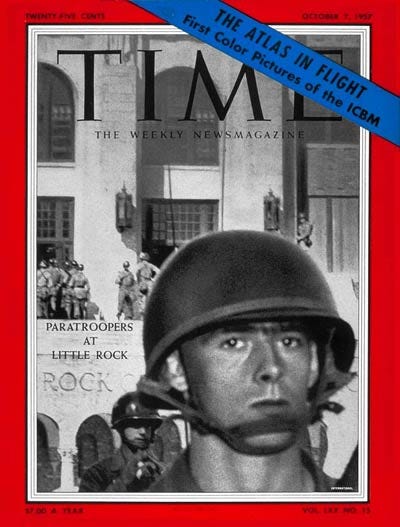
PB: With the total applause from the Main Stream Media, which was then, of course, completely oligopolistic.
At least now we have Twitter, even if we are shadow-banned on Twitter.
TC: Are you still shadow-banned?
PB: Oh, yeah. Well, as far as we can see, we are.
Ann Coulter, you know, her followership has not risen for, like, six years. It’s been 2.1 million for six years. It doesn’t go up, it doesn’t go down.
I mean, it’s obvious. You can see from engagement that there’s something very strange going on.
It’s all the Indians he has in there. He hasn’t been able to root them out!
TC: Thank you very much.
PB: Thank you!
As a NON white American I totally agree about the dangers of unchecked mass immigration!
Great to see you getting some coverage from a big name like Carlson. You deserve it far more than Fuentes.
Rather than calling Israel an ethnostate in the strictest sense, though... I think it's fairer to say that Israel has an immigration policy that aims not to make it's internal diversity problems worse. (Between the arabs, mizrahim, beta israel, haredi, atheist/liberal/socialist blocs and a surprisingly large illegal-alien contingent overstaying work visas, the population doesn't really have a huge amount in common either genetically or culturally, which produces all the problems you might expect. The core founding secular-ashkenazim stock were outnumbered a long time ago.)
It would be more accurate to say that Israel is actively trying to move in an ethnostate-like direction, in terms of both who-gets-in and a very slow process of internal ethnogenesis and ultra-orthodox takeover. It's debatable whether the constituent denominations would cohere at all if they didn't have so many common enemies.