

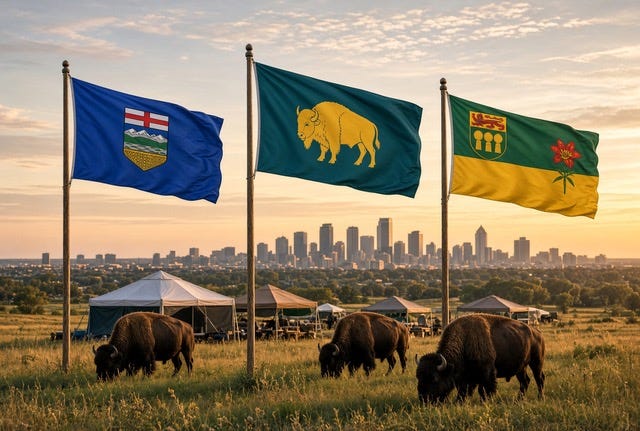
Thanks to https://substack.com/@fergushodgson for image. Flag on Left, province of Alberta, flag on right, province of Saskatchewan. Middle flag…a future Prarie nation?
Canada’s French-speaking Canadian province of Quebec elected a separatist government on October 5.
This amused me, because I predicted in my much-denounced 1986 book The Patriot Game

that Pierre Trudeau’s attempt to reengineer Canada into a bilingual, multicultural post-national monstrosity—dramatically accentuated by the elite-driven implosion of Britain—could not, in the end, appease Francophone (= French-speaking in Ottawa-speak) identitarianism. It would just dispossess Anglophone (= English-speaking) Canada.
And here we are.
Similarly, on October 19, the oil-rich province of Alberta (which, by the way, is about the same size as Lydia’s home state of Texas) will vote on a rather mealy-mouthed referendum to start the process of negotiating secession.
Everyone says this referendum will lose, with maybe 20-25% of the vote. And maybe that’s right. English Canada is apparently in the grip of Trump Derangement Syndrome, exacerbated by its hegemonic Central Canadian media’s mainlining the U.S. MSM—in itself proof that the the two countries are in fact inextricably interlinked.
But I’m equally amused by the emergence of Alberta separatism, because I also predicted it in The Patriot Game (see “dispossess,” above).
So here we are again.
And, unlike Quebec, Alberta is not just a cultural but also a flat-out economic loser in Canada’s Confederation—see this brilliany analysis here. It’s actually amazing that Alberta has stood still for this for so long.
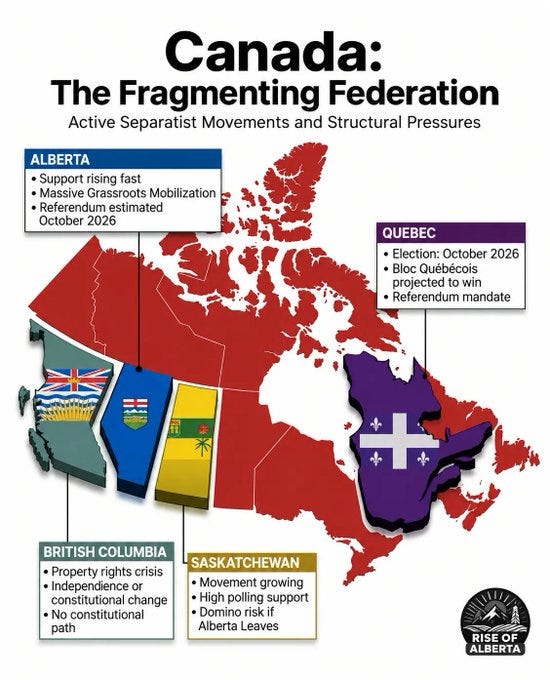
The possibility of Western separatism was met with utter incredulity by the Central Canadian elite when I reported it 40 years ago.
You’ve heard of the Will To Power. In Canadian politics, there is a Will To Complacency
A week is notoriously a long time in politics. Yet decades can pass in the blink of an eye.
And so here we are (see above). Alberta separatism has finally forced itself into the public agenda.
And if it loses this time? I recommend to Alberta separatists what separatist premier Renee Lévesque said after losing the 1980 referendum: “A la prochaine fois”—until the next time.
And in fact the subsequent 1995 referendum only lost by 1.2%.
Care to bet against the trend?
The point is that are fundamental forces underlying Quebec’s move to independence that cannot be debated away.
And in English Canada?
Identities brew up very quickly in the Anglosphere. England itself, of course. is a thousand years old. But the United States of America was notoriously rampant in less than two hundred. And the States of the Deep South, Louisiana, Alabama and Mississippi, were less than fifty years old when their men fought to the death in defence of the newly-brewed Confederacy.
And these identities morph—for example,, the entire Anglosphere now faces the threat of non-traditional immigration.
I opened The Patriot Game by stipulating eight points about Canada, which I will summarize in truncated form here. I am happy to report that when I was writing this, the late Arnold Beichman, married to a Canadian woman and trapped in my Manhattan loft because National Review Editor John O’Sullivan was late as usual for lunch, whooped happily in agreement.
1] There at at least two and conceivably seven incipient subnations within Canada
2] Quebec is a genuine nation-state
3] Anglophone Canada is part of a greater English-speaking North American nation
5] Canada’s political system is badly designed, and misrepresents Canadian reality
6] Canada has an unusually large New Class—a group inventing polices that benefit itself (currently anti-Trumpism) and seeking rents from e.g. transfer payments, bilingualism, affirmative action,.
7] This new Class has developed a Gramscian”Dominant Ideology” (egalitarian, multicultural) which has replaced Canada’s former (British, Imperial) identity,
8] Canada’s politics are volatile, disguised by the Parliamentary system and the first-past-the-post system.)
Pat Buchanan immediately saw what I was driving at, from an America First point of view, and wrote the column posted below.
For the record, I now think that, until the U.S, gets its immigration disaster under control, Alberta would be better off with some sort of associate status.
Is Annexation Of Canada In The Cards For US?
by Patrick J. Buchanan. Originally published January 18, 1988, reposted on VDARE.com November 29, 2011
Twelve decades ago. we Americans made our last serious effort to annex Great Britain’s vast possessions to the north, Irish veterans of Grant’s Army of the Potomac, Fenians they called themselves, decided to capture Canada, provoking a war with Great Britain, out of which would come the liberation of the Emerald Isle. Their battle hymn ran thus:
“We are the Fenian Brotherhood, skilled in the art of war.
And we’re going to fight for Ire’ land, the land that we adore.
Many battles have we won, along with the boys in blue,
And we’ll go and capture Canada, for we’ve nothing else to do.”
The Fenian boys made a mess of it: after crossing the Niagara River and prevailing at “the Battle of Limestone Ridge.” Parliament, irate at the newest manifestation of Yankee greed, passed the British North America Act, creating the Dominion of Canada. A little patience, and Canada, or parts of it like British Columbia, might have fallen peace fully into the lap of the United States. But the Irish-Americans blew it.
Comes now a book suggesting that the break-up of Canada, with the English-speaking Maritime and western provinces moving into close association with the United States, may be only a matter of time.
The Patriot Game [free pdf.]
was penned by Forbes editor Peter Brimelow, a British expatriate living in New York. who spent seven years in Canada. Brimelow’s thesis runs thus:
In recent decades, the dominant Liberal Party has prevented Quebec from breaking free, and Canada from breaking up only through the cultural and economic appeasement of Montreal. Having adopted a constitution making Canada bilingual, Ottawa has rigorously imposed the French language on the state bureaucracy and the English-speaking provinces, while allowing Quebec to institute policies of rank discrimination against her Anglophone minority. English speaking Canada is being massively taxed for income transfers to raise Quebec’s standard of living to the national average. Given a crisis, the arrangement could collapse.
Other strains are surfacing. Ottawa’s socialist and protectionist policies have impoverished the nation. leaving Canadians with 70 percent of the standard of living of Americans (roughly the same as America’s blacks) though Canada is richer in resources, freeloads on Western defense, and has no vast urban underclass to support.
The “patriot game” is “Canadian nationalism,” which Brimelow derides as a “fraud,” a hoax, promoted by Canada’s New Class of academics, journalists, bureaucrats and a business elite to keep out American imports and American magazines, films, books and television shows against which Canada’s media magnates cannot compete. The average Canadian is not anti-American. Brimelow writes: America’s problem lies with the Ottawa and Toronto elites, who appease Quebec and milk the outer provinces.
Quebec is becoming more and’ more French, more and more separate In character from English- speaking Canada, which has more in common, culturally, linguistically, economically, with the Americans, than with Canada’s New Class.
“I don’t even know what street Canada is on,” Al Capone of Cicero, Ill., once observed, nicely encapsulating the attitude of most Americans. But Americans would do well to pay attention to a neighbor with one- tenth our population, who possesses as much of the earth’s surface (6 percent) as does the United States.
I thought black americans only had about 50% of white-americans' income levels?