

Please Sign Up As A PAID Subscriber: Remember, I’m only on Substack because VDARE was forced to suspend operations by NYAG Letitia James’s lawfare, so if you’re a free subscriber, please upgrade to paid!
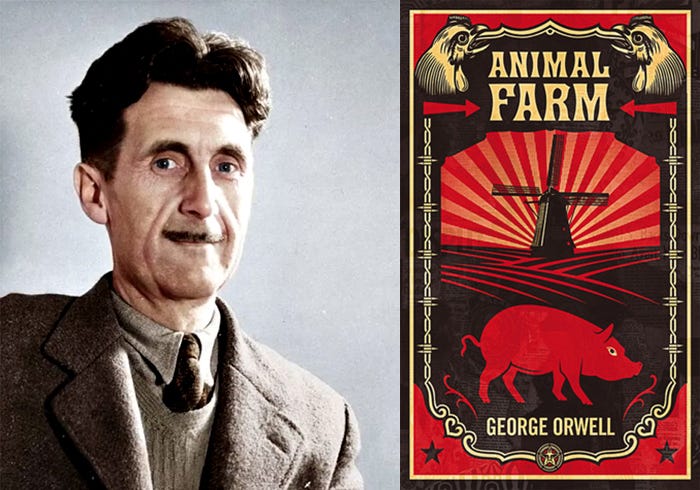
Andy Serkis (who played Gollum in THE LORD OF THE RINGS) has gotten hold of George Orwell’s great anti-Communist fable ANIMAL FARM, and is issuing a bowdlerized anti-Trump, anti-Musk animated version:


According to the USA TODAY story linked above:
When [Orwell]wrote “Animal Farm,” he intended it as an allegory for the Russian Revolution and rise of Stalinism. Barnyard animals overthrow their farmer to build a utopia, but by the end of the novel it has devolved into a corrupt power structure in which “all animals are equal, but some animals are more equal than others.”
Serkis approached the adaptation by asking himself what Orwell would write about if he wrote “Animal Farm” today. He didn’t want it to be a story about Stalinist Russia. Instead, he gravitated toward themes of capitalism, wealth and overconsumption. The billionaire antagonist, Pilkington (Glenn Close), drives what closely resembles a Cybertruck.
You can watch the trailer below:
The USA TODAY story goes on about Serkis making it lighter and more comical:
Serkis scrubs the story of its violence, at least in any graphic manner. Snowball (Cox), for example, is escorted off the farm rather than chased by hounds and torn to pieces like in the book. Boxer’s (Harrelson) horrific glue factory death is largely implied. It didn’t stop Serkis’ team from giving me a promotional bottle of craft glue with the horse’s face on it, though. I’m not sure how this bit of dark humor will go over with the kiddos.

In fact, Snowball doesn’t die in the book. Snowball (who represents Leon Trotsky ) is chased away Napoleon's [Stalin’s] dogs, resulting in Napoleon [Stalin] “effectively assuming supreme command.”
In real life, on the other hand, Leon Trotsky was assassinated in Mexico in 1940—not torn to pieces by dogs, but killed with an ice axe by a KGB agent.

In 1945, when Orwell was trying to publish Animal Farm, he had difficulty doing it, on both sides of the Atlantic Ocean, because the publishing industry was controlled by Stalin’s friends.
Publishing is nominally a capitalist industry, like Hollywood, but both will reject an obvious bestseller if it goes counter to the Narrative.
On January 21, 2015, literary agent Jonny Geller tweeted
How can we not mark George Orwell's death this day in 1950 by recalling Knopf's priceless rejection of Animal Farm?
And added that image:
![Stupid and pointless fable in which the animals take over a farm and run it, and their society takes about the course of the Soviet Union as seen by Westbrook Pegler. It all goes to show that a parallel carried out to the last detail is boring and obvious. Even Pegler gets off a few smart lines now and then but this is damn dull. Very very NFK. [Not For Knopf]](https://substackcdn.com/image/fetch/$s_!dnrI!,f_auto,q_auto:good,fl_progressive:steep/https%3A%2F%2Fsubstack-post-media.s3.amazonaws.com%2Fpublic%2Fimages%2F165ba4a6-df60-427b-ad3b-c416f632c290_640x637.jpeg "Stupid and pointless fable in which the animals take over a farm and run it, and their society takes about the course of the Soviet Union as seen by Westbrook Pegler. It all goes to show that a parallel carried out to the last detail is boring and obvious. Even Pegler gets off a few smart lines now and then but this is damn dull. Very very NFK. [Not For Knopf]")
The text of that says
Stupid and pointless fable in which the animals take over a farm and run it, and their society takes about the course of the Soviet Union as seen by Westbrook Pegler. It all goes to show that a parallel carried out to the last detail is boring and obvious. Even Pegler gets off a few smart lines now and then but this is damn dull. Very very NFK. [Not For Knopf]
The point of this is that Knopf, a major publishing house which had at least one actual Communist editor, Angus Cameron—when a New York Times obituary is headlined “forced out during McCarthy era” (November 23, 2002), that generally means “Communist”—rejected Animal Farm because it reflects “Soviet Union as seen by Westbrook Pegler”.
If you’ve forgotten, or never learned, about Westbrook Pegler, he was the 1940s equivalent of Glenn Beck, an anti-Communist, anti-New Deal syndicated columnist who worked for William Randolph Hearst. And in those days the pro-Communist Left (sometimes they would call themselves anti-anti-Communist) was very powerful.
Slate thought it worthwhile to attack Pegler posthumously in 2004, [Dangerous Minds | William F. Buckley soft-pedals the legacy of journalist Westbrook Pegler in The New Yorker, By Diane McWhorter, March 4, 2004] and it was weird to see how when Sarah Palin quoted something innocuous Pegler said (about growing “good people in our small towns”) Leftists went and dug up hateful quotes Pegler said to attack her with.
The point here: Knopf knew, institutionally, that it was supposed to reject books that challenged the Narrative.
T.S. Eliot, not an actual Communist, also rejected this book in 1944 on behalf of British publishers Faber and Faber, on the principle that Stalin was Britain’s wartime ally:
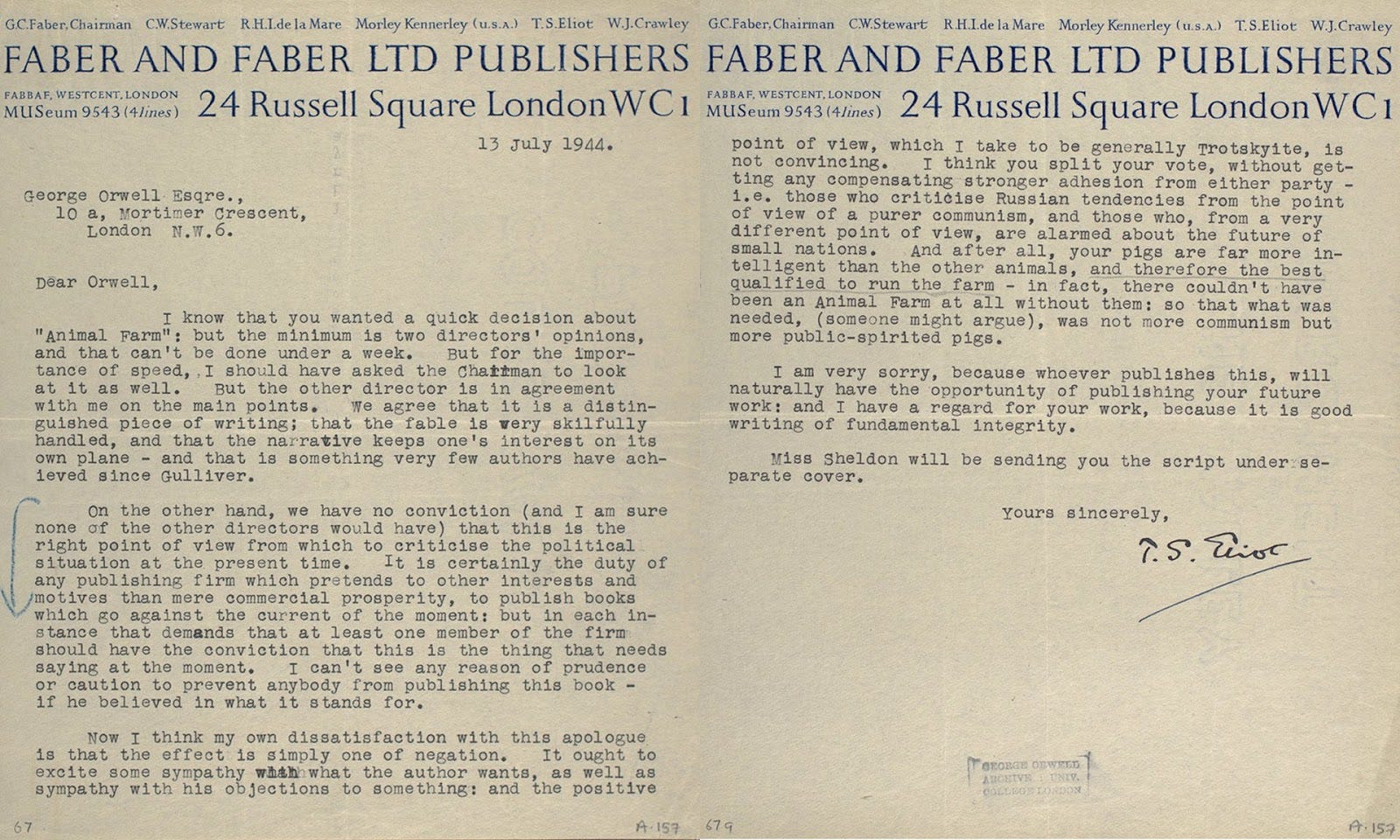
In a letter from 1944 explaining why he would not be publishing the work, Eliot told Orwell that he was not persuaded by the “Trotskyite” politics which underpin the narrative. To publish such an anti-Russian novel would jar in the contemporary political climate, explained the poet.
“We have no conviction ... that this is the right point of view from which to criticise the political situation at the present time. It is certainly the duty of any publishing firm which pretends to other interests and motives other than mere commercial prosperity to publish books which go against the current of the moment,” wrote Eliot, before going on to say that he was not convinced that “this is the thing that needs saying at the moment.”
Eliot was also rejecting a book that challenged the Narrative, although he had the excuse that the Soviets were technically a wartime ally of Great Britain.
But publishers enforcing the Narrative is very powerful.
Thus in 1995, Jacob Weisberg, reviewing VDARE.com Editor Peter Brimelow’s Alien Nation in New York magazine, complained that Random House had failed in its duty protect the Narrative:
Not so long ago, the literature of egregious bigotry was treated like pornography. You had to send for it by mail—from backwoods presses that advertised in the classified sections of conservative magazines—or frequent the political equivalent of dirty bookstores. Today, you just walk into any Barnes & Noble. The Free Press set the precedent last fall with Charles Murray and Richard Herrnstein‘s The Bell Curve, which argued that blacks are genetically less intelligent that whites. Now comes Random House with Peter Brimelow’s Alien Nation., another expression of intellectualized white rage that attempts to do for immigrants, and Hispanics in particular, what Murray did for blacks. Odds are it will enrage sensible folk, convince no one, and earn a small fortune. [Links added—the original was on paper.]
Wait: “earn a small fortune”? Don’t publishers like a small fortune?
You wouldn’t believe how many copies of Animal Farm the people who did publish it sold (20 million Signet paperbacks, and that’s just one edition) and both Alien Nation and The Bell Curve were bestsellers.
I noted this when American Renaissance’s Jared Taylor published his 1992 book Paved With Good Intentions as a Kindle book—now the only format in which it is available. (The original publisher regrets having published it and won’t reprint it.)
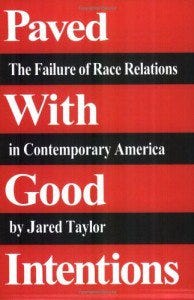
In the 90s, there was what we at VDARE.com called an “interglacial” period in which many books were published that couldn’t be published today, or previously, for that matter, in the 70s and 80s. Animal Farm shows what couldn’t even be published in the 40s. (They could have been published in the 1920s—in fact, they more or less represented the conventional wisdom. See historical examples like Madison Grant, and Lothrop Stoddard.)
Many of them earned small fortunes, as Weisberg suggested, and they did convince people.
The most recent case is Ann Coulter’s great book Adios, America: The Left’s Plan to Turn Our Country into a Third World Hellhole, which convinced Donald Trump to run for President in 2015.

Jacob Weisberg may have been right in 1995 to think that you could only buy politically incorrect books from “backwoods presses that advertised in the classified sections of conservative magazines.” (“Backwoods” here means anywhere outside New York City.)
But now you can order the following books on your Kindle, iPhone, iPad or computer with a click of the mouse, and no one in New York can stop you:
Alien Nation, by Peter Brimelow
Paved With Good Intentions, by Jared Taylor
White Identity, by Jared Taylor
The Birth Of Prudence, by Ryan Andrews
From The Dissident Right, By John Derbyshire
Of course, those are books that you have to pay for. Additionally, you can also obtain many out-of-copyright works for free from Project Gutenberg and Archive.org.
Remember what I said about Lothrop Stoddard and Madison Grant? Their books are available for free—and so is Paul Buck’s 1937 book The Road To Reunion, another book that couldn’t be published today, because its author failed to hate the South.
I’ve been telling people for years on the internet that if you can read what I’m writing, you can read an e-book.
And now, in 2026, we see Jonathon Keeperman’s Passage Press publishing all kinds of books that Jacob Weisberg, above, would not approve of.
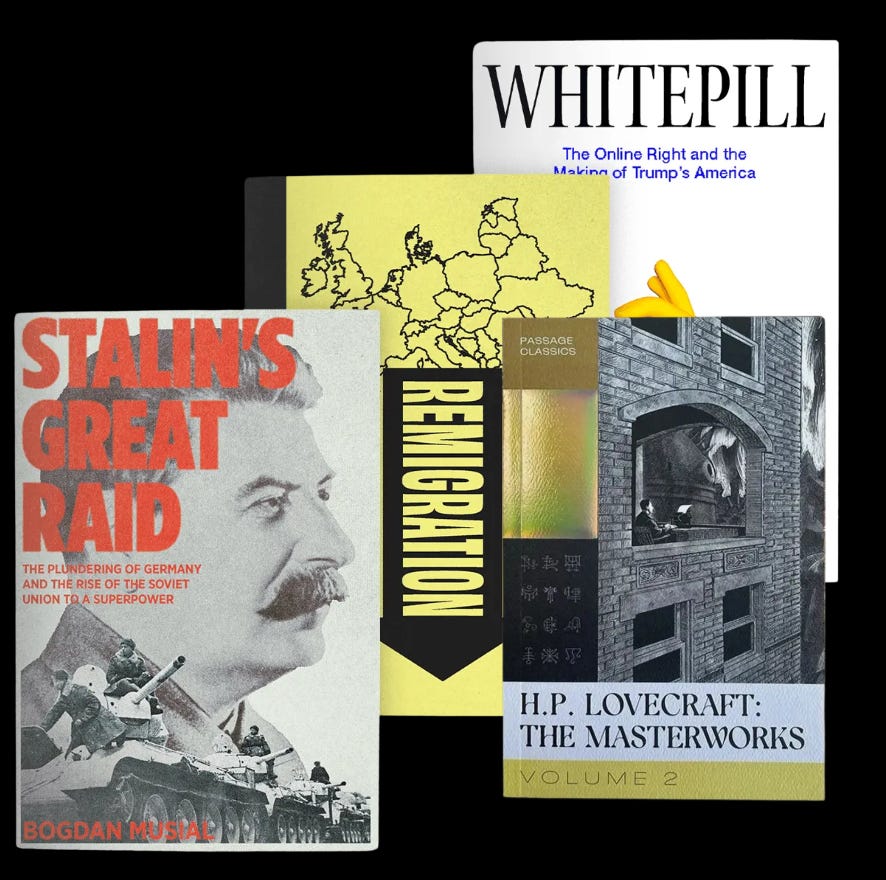
You know how people keep saying “It’s not your father’s America”? Well, it’s not your father’s New York publishing cartel either.
James Fulford has been writing about the national question for over 20 years, mostly for VDARE.com, more recently for WhitePapers.